
PEGI – The pan-European content rating system
Helping parents make informed decisions
PEGI (Pan-European Game Information) was founded in 2003 at the request of the EU institutions. As a co-regulatory age rating system for video games. The system is a part of the industry’s commitment to protect minors and to build trust with consumers by ensuring that reliable information about video game content is provided in a responsible manner. All the major game platforms use the PEGI ratings as part of their parental tool systems.
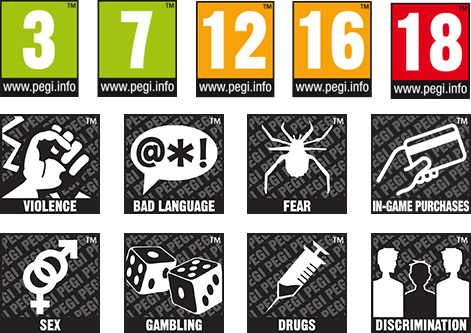
PEGI’s goal is to educate, advise and empower parents and guardians on age appropriate content in video games, not the game’s level of difficulty. The classification system comprises 5 age categories and 8 content descriptors. For more details, click here.
In 2023, PEGI celebrated 20 years. It is used and recognised throughout Europe – PEGI rated products are distributed in 40 countries across Europe – and it has the enthusiastic support of the European Commission. It is considered as a model of European harmonisation in the field of minor protection and consumer transparency. In the course of 20 years, PEGI has classified 40,000 video games, counting more than 2800 companies as signatories, including all the major publishers. Research shows that 80% of parents with children that play video games aware of PEGI age rating labels.
2026: PEGI expands age rating criteria with interactive risk categories
PEGI announced that starting in June 2026, its age-rating criteria will include new ‘interactive risk’ categories such as optional purchases of in-game content, paid random items, play-by-appointment mechanisms, and unrestricted online communication. This change means that these game features may automatically trigger higher age ratings.
The update ensures that PEGI ratings not only reflect traditional content (e.g. violence or bad language) but also modern online gameplay features – helping parents and families better understand the full experience a game may offer.
2003
PEGI launch in Europe
2007
PEGI online
2013
PEGI joins IARC
2015
PEGI on mobile and tablets
2016
More than 30.000 licences issued
2018
More information on purchase of in-game content
2020
Launch of the PEGI app
2023
Focus on lootboxes
2026
Inclusion of new 'interactive risks' categories
The PEGI App
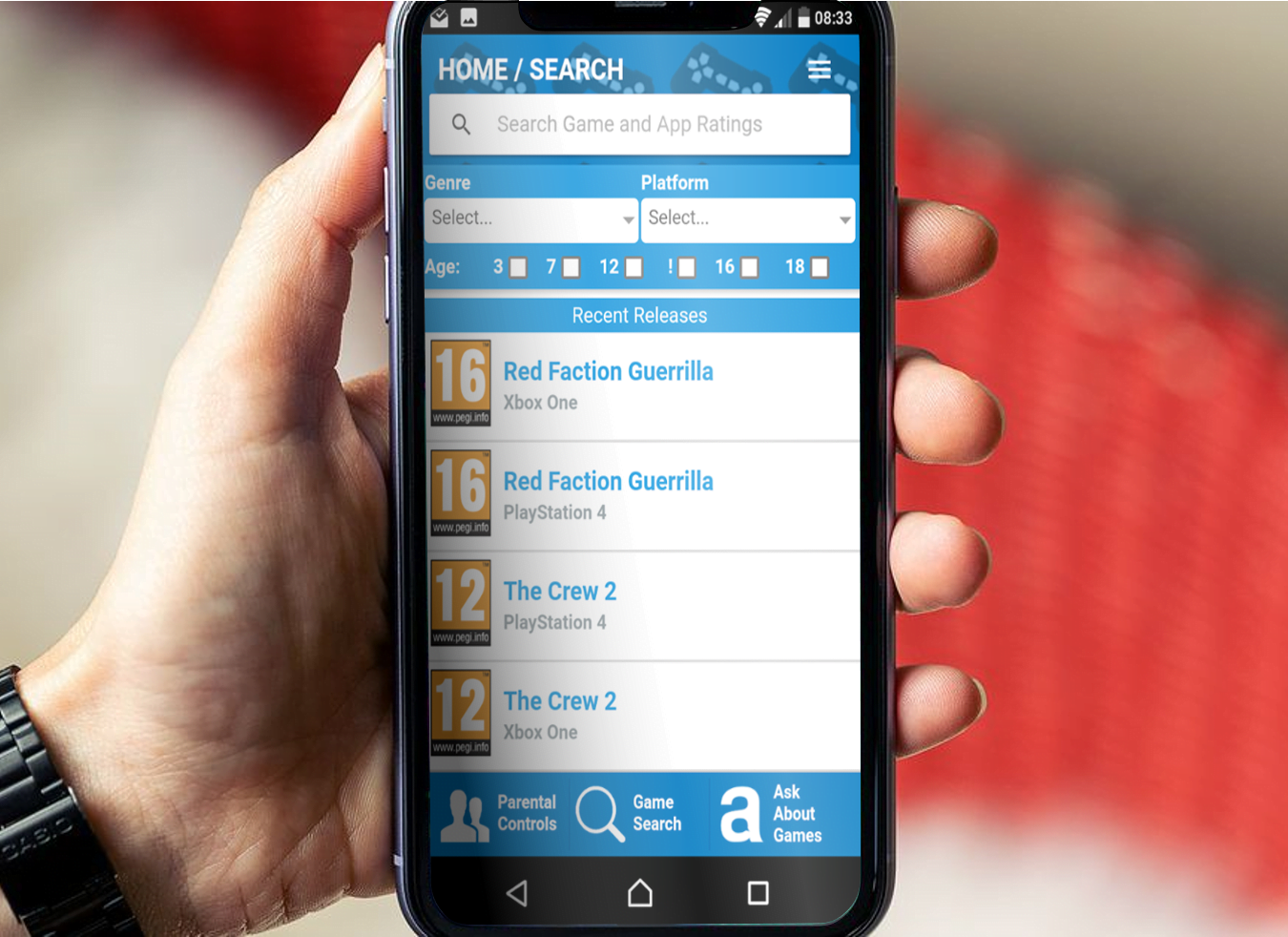
The PEGI App was launched in 2019, allowing users to check the ratings and content of PEGI-rated games on a smartphone. It allows users to search the PEGI database for up-to-date video game and app ratings. Results can be filtered by age rating, genre and platform to find the right game and get detailed instructions on how to set up parental tools on a range of devices. The app is available in 15 languages: English, French, Polish, Dutch, Italian, Spanish, Portuguese, German, Swedish, Norwegian, Finnish, Danish, Croatian, Serbian, and Romanian.
PEGI Code of Conduct
PEGI was designed to ensure maximum robustness for making recommendations to European consumers, especially parents, about the suitability of video game content. Each publisher that joins PEGI has to sign a Code of Conduct by which it is committed to provide parents with objective, intelligible and reliable information regarding the suitability of a game’s content. By signing the Code the publisher also aims to secure consistency in the advertising of a product, and to refrain from putting products on the market likely to be in breach of human decency.
In 2007 PEGI Online Safety Code was launched, an EU-funded project which developed new standards for online games. This led to an update of the PEGI Code of Conduct to take into account the online environment and added the obligation to keep gameplay free of illegal and offensive user-created content, provide user-friendly reporting mechanisms and maintain an effective protection of privacy. You can read more about the online safety code here.
In 2023, PEGI updated its Code of Conduct to include In-game Monetisation and a minor update to PEGI Online System, which combines a set of provisions to ensure safe online gameplay for minors. The updated Code of Conduct will come into effect on 19 April 2024 (after a 6 month grace period). At this time, the elements that PEGI will actively monitor include:
- the In-Game Purchases descriptor as well as the Paid Random items notice for loot boxes which must be displayed at the point of purchase (Article 8.2)
- if the game has paid random items, it must inform players about the probabilities to obtain items (Article 8.3)
- the game must have a policy that explicitly prohibits the unlawful trading of in-game items (Article 8.4)
As well, PEGI will verify that:
- terms of service with players must prohibit the introduction of content that is illegal and/or harmful (Article 9.2)
- the online gameplay environment must have a mechanism for players to notify about such illegal and/or harmful content, and this content should be removed as quickly as possible (Article 9.3)
- company must have an effective privacy policy in place (Article 9.7)
The updated full Code of Conduct is here.
Always adapting to an evolving market
The video game industry is constantly evolving, and PEGI’s objective and mission are to accompany the industry in its evolution. PEGI is continuously evaluating its rating system and the underlying criteria, while also working on new solutions to address the concerns of the general public and parents in particular. In 2007, PEGI was expanded to cover the online environment to help parents understand the risks and potential for harm within this environment. Learn more here. Innovations like virtual reality, new monetisation techniques, and features like social interaction are constantly monitored and assessed, which is what led to the 2023 and 2026 updates. An international group of independent experts assists PEGI in keeping the rating criteria relevant and up to date.
What about the rest of the world?
In 2013, PEGI co-founded the International Age Rating Coalition (IARC), a global cooperation of age rating boards to provide the fast-moving mobile and digital markets with a scalable solution to implement familiar age rating systems. PEGI ratings are also used in Google Play for all Android devices and in other digital storefronts like the Microsoft Store, the PlayStation Store, the Nintendo eShop and the Oculus store.